

Revenue is vanity. Profit is sanity. You can pull in $500,000 a year and still be one bad quarter away from closing — or you can make $150,000 and keep a third of it. The difference is your profit margin: the single number that tells you how much of every dollar you actually get to keep.
If you run a small business or freelance practice, you should know the profit margin formula cold. Not just because your accountant asks about it, but because it answers the questions that actually run your business: Can I afford to raise my prices? Am I undercharging? Where is the money leaking?
Here’s everything you need: the formulas (gross, operating, and net), worked examples with real numbers, benchmarks by industry, and the mistakes that make margins lie to you.
The Profit Margin Formula (Simple Version)
The basic profit margin formula is:
Profit Margin = (Profit ÷ Revenue) × 100
That’s it. Take the profit you want to measure, divide it by total revenue, and multiply by 100 to get a percentage.
The catch: “profit” means three different things, depending on how deep down the income statement you go. Each version of the profit margin formula tells you something different about your business:
- Gross profit margin — how efficiently you produce what you sell
- Operating profit margin — how efficiently you run the business
- Net profit margin — your true bottom line, after everything
Let’s walk through each one with examples.
Gross Profit Margin Formula
Gross Profit Margin = [(Revenue − Cost of Goods Sold) ÷ Revenue] × 100
Cost of goods sold (COGS) is what it costs to produce your product or deliver your service — materials, direct labor, subcontractor payments. It does not include rent, software, advertising, or your salary.
Example: A bakery
A small bakery earns $20,000 in a month. Ingredients and baking labor (COGS) cost $8,000.
- Gross profit = $20,000 − $8,000 = $12,000
- Gross margin = ($12,000 ÷ $20,000) × 100 = 60%
A 60% gross margin means every dollar of sales generates 60 cents before operating expenses. For a bakery, that’s healthy — most food businesses land between 50% and 70%.
Gross margin is your early-warning system for pricing and production costs. If it’s shrinking while revenue grows, you’re either underpricing or your input costs are climbing — and you need to act before the damage reaches your bottom line.
Operating Profit Margin Formula
Operating Profit Margin = [(Revenue − COGS − Operating Expenses) ÷ Revenue] × 100
Operating expenses are the costs of running the business day to day: rent, utilities, insurance, software subscriptions, marketing, administrative wages.
Continuing the bakery: after COGS of $8,000, operating expenses (rent, insurance, POS fees, part-time cashier) total $6,000 a month.
- Operating profit = $20,000 − $8,000 − $6,000 = $6,000
- Operating margin = ($6,000 ÷ $20,000) × 100 = 30%
Operating margin shows how well you control the overhead of the business, separate from taxes and debt payments. It’s the number investors and buyers look at first, because it reflects how the business itself performs — independent of how it’s financed.
Net Profit Margin Formula
Net Profit Margin = [(Revenue − All Expenses, Including Taxes and Interest) ÷ Revenue] × 100
This is the bottom line: after every expense — COGS, operating costs, loan interest, and taxes — what’s left?
Example: A freelance designer
A freelance brand designer bills $120,000 a year. Her costs:
- Software and tools: $2,400
- Home-office expenses: $3,600
- Health insurance: $7,200
- Contractor help (a developer for a big project): $8,000
- Taxes (income + self-employment tax): $22,000
- Miscellaneous (co-working, marketing, fees): $4,800
Total expenses: $48,000. Net profit: $120,000 − $48,000 = $72,000.
- Net margin = ($72,000 ÷ $120,000) × 100 = 60%
Service freelancers often have net margins of 40–70% because they carry almost no COGS. That’s the quiet advantage of selling expertise instead of inventory.
If your own freelance math feels murky, run your numbers through a free profit margin calculator — plug in revenue and expenses and see your gross, operating, and net margins instantly.
Gross vs. Net Profit Margin: What’s the Difference?
Think of the three margins as a funnel:
- Gross margin asks: Is the thing I sell fundamentally profitable? (revenue minus direct costs)
- Operating margin asks: Do I run the business efficiently? (also minus overhead)
- Net margin asks: What do I actually keep? (minus taxes and financing costs)
A business can have a great gross margin and a terrible net margin. A restaurant with a 65% gross margin can still lose money if rent and labor eat the rest. That’s why you should always track all three — gross margin diagnoses your pricing, net margin diagnoses your business.
What Is a Good Profit Margin for a Small Business?
There’s no universal “good” number — it depends heavily on your industry. As rough benchmarks (US small-business averages):
| Industry | Typical net margin |
|---|---|
| Professional services (consulting, design, legal) | 20–40% |
| Software / SaaS | 15–25% |
| Retail | 2–5% |
| Restaurants | 3–9% |
| Construction | 3–7% |
| Health and personal care | 8–15% |
The golden rule: compare yourself to your own industry, not to someone else’s. A 10% net margin would be a crisis for a consultancy and a triumph for a grocery store. Track your margin trend over time — a stable or rising margin matters more than hitting any magic number.
How to Calculate Profit Margin: Step by Step
- Pick a period. Monthly works for most small businesses; annual is better for seasonal ones.
- Total your revenue. All sales, all income — gross receipts before any expenses.
- Total your costs by type. Separate COGS (direct costs) from operating expenses, and operating expenses from taxes and interest.
- Apply the formula. (Profit ÷ Revenue) × 100 — using whichever profit level you want.
- Track it monthly. One calculation is a snapshot; twelve in a row is a story. Rising revenue with a falling margin means costs are outpacing growth.
Don’t have a clean expense list yet? A business expense tracker makes step 3 painless — log costs as they happen and your margin math takes minutes instead of a weekend.
5 Mistakes That Make Profit Margins Lie
- Forgetting your own labor. If you pay yourself $0 on paper, your margins look great and your life looks broke. Always include a reasonable salary for your own work.
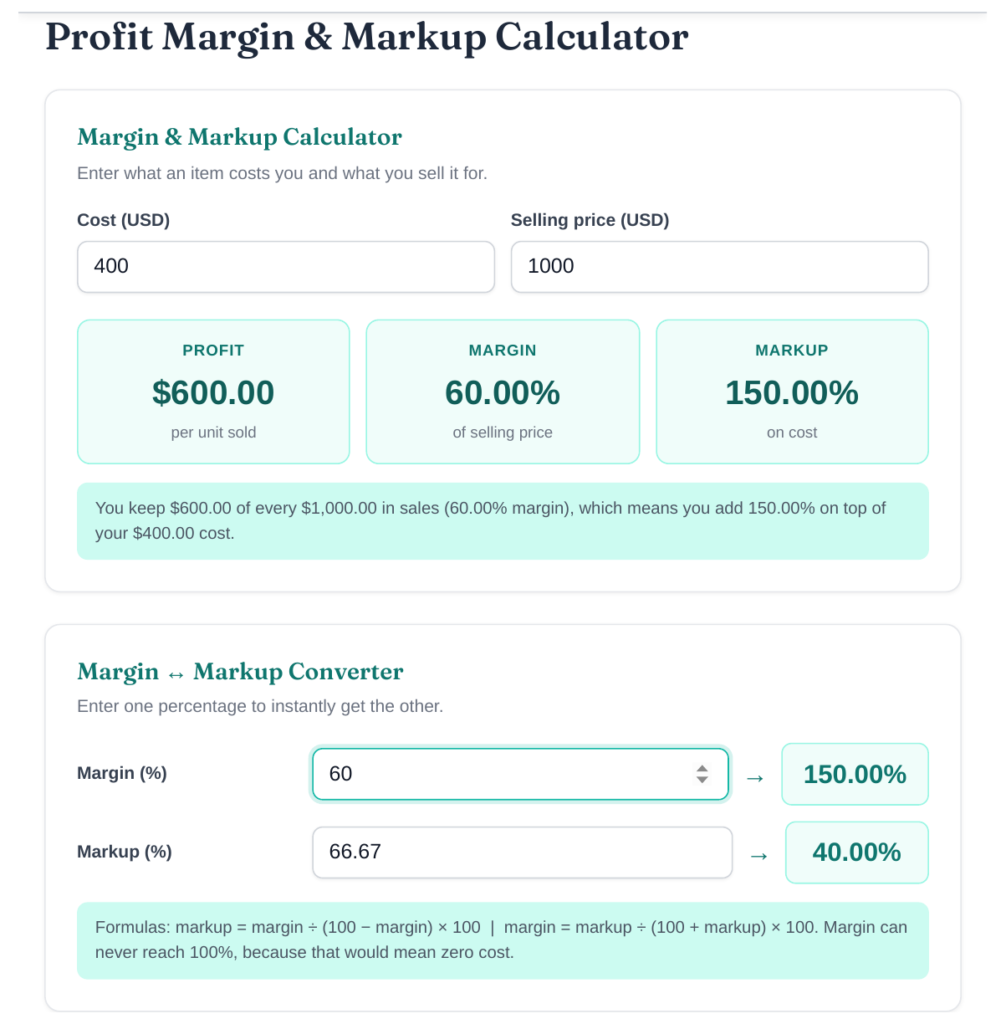
- Mixing markup and margin. Markup is profit ÷ cost; margin is profit ÷ revenue. A 50% markup is only a 33% margin. This single confusion causes more bad pricing decisions than anything else.
- Counting owner draws as expenses. Drawing money from the business isn’t an expense — it’s you taking profit. It belongs below the margin line.
- Using cash accounting blindly. If you invoice $30,000 in December but get paid in January, your December margin looks catastrophic. Match revenue to the period it was earned.
- Ignoring taxes. Plenty of businesses celebrate a 30% operating margin, then panic in April. Estimate your real tax burden — a self-employment tax calculator helps if you freelance — and work with after-tax numbers for planning.
How to Improve Your Profit Margin
Once you know your number, there are only three levers:
- Raise prices. Even 5% on a 20% margin is a 25% profit increase. Most small businesses underprice by far more than they realize.
- Cut costs that don’t create value. Audit every subscription, renegotiate with suppliers, and kill the marketing that doesn’t convert. Your margin formula shows the damage; fixing it is a business decision, not a math problem.
- Sell more of what has the best margin. Calculate margin per product or service. The service that’s 10% of your revenue but 40% of your profit deserves more of your week.
Frequently Asked Questions
What is the profit margin formula?
Profit margin = (Profit ÷ Revenue) × 100. Use gross profit for gross margin, operating profit for operating margin, and net profit (after taxes and interest) for net margin.
How do you calculate profit margin with an example?
If your business earns $100,000 and all expenses total $75,000, your net profit is $25,000. Divide by revenue: ($25,000 ÷ $100,000) × 100 = a 25% net profit margin.
What is a good profit margin for a small business?
It depends on the industry. Professional services typically run 20–40% net margins, while retail runs 2–5% and restaurants 3–9%. Compare against your own industry and, more importantly, against your own trend over time.
What is the difference between profit margin and markup?
Markup is profit as a percentage of cost (profit ÷ COGS × 100); margin is profit as a percentage of revenue (profit ÷ revenue × 100). A 50% markup equals a 33.3% margin — confusing the two is one of the most common pricing mistakes small businesses make.
Should freelancers track profit margin?
Absolutely. Freelancers typically carry almost no COGS, so gross and net margins are close — but taxes, tools, insurance, and subcontractors add up. Tracking net margin quarterly keeps you honest about what you’re actually keeping, and it tells you exactly when it’s time to raise your rates.
Know Your Number
Your profit margin is the truest measure of your business’s health — more honest than revenue, more useful than vibes. Calculate it this month, then make it a habit. The businesses that survive aren’t the ones that sell the most. They’re the ones that keep the most.
Run your numbers now with our free profit margin calculator — enter your revenue and expenses to see your gross, operating, and net margins in seconds, and start pricing with confidence.
Tools mentioned in this guide: hourly rate calculator, ROI calculator.
Sources
- Industry net-margin ranges (professional services 20–40%, retail 2–5%, restaurants 3–9%, etc.) are rough U.S. small-business averages for orientation only, not official statistics.